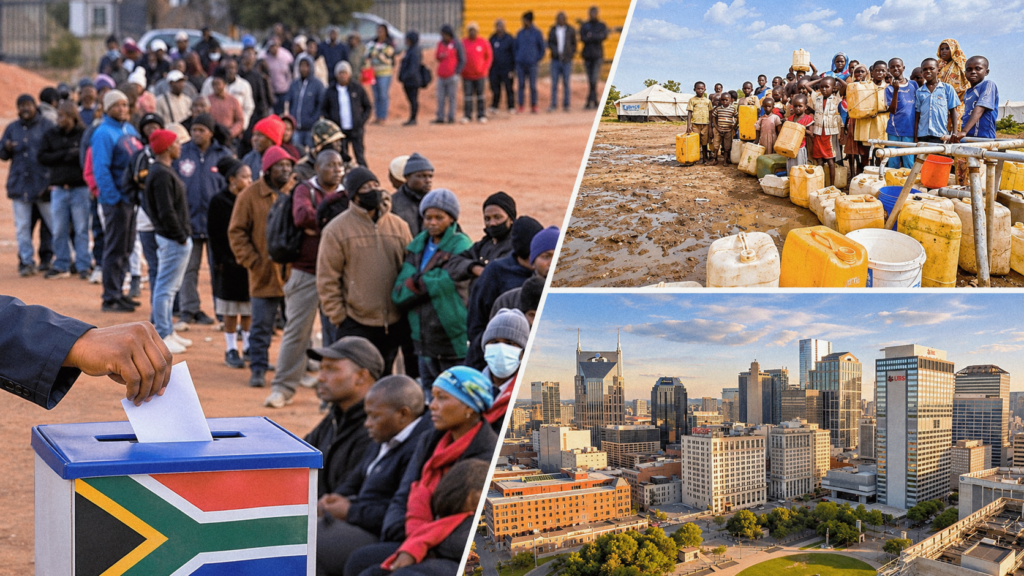
South Africans headed to the polls on Wednesday in municipal elections that could further weaken the governing African National Congress (ANC), as growing frustration over corruption, crime, unemployment and deteriorating public services shapes voter sentiment.
The elections are being closely watched as the ANC faces the possibility of losing further support after its vote share fell below 50% for the first time in municipal elections in 2021. Opinion polls suggest the party could fall below 40% in this election.
With no single opposition party expected to secure an outright majority in several major metropolitan areas, coalition governments are likely to remain a defining feature of South Africa's local political landscape.
President Cyril Ramaphosa acknowledged the challenges facing local government after casting his vote in Johannesburg, saying the ANC was determined to rebuild municipal structures and improve governance.
Among voters' biggest concerns are unreliable electricity and water supplies, high unemployment, rising crime and a shortage of affordable housing.
For many residents, the election represents an opportunity to demand improvements in basic service delivery. However, concerns remain that closely contested results could produce hung municipal councils and fragile coalitions, potentially complicating efforts to address longstanding infrastructure and governance problems.
Johannesburg Emerges as the Biggest Electoral Prize
Johannesburg, South Africa's commercial centre, is attracting particular attention as one of the most closely watched contests.
The city has experienced seven mayors since 2021, following repeated coalition breakdowns. Residents continue to face disruptions to water and electricity supplies, damaged roads, potholes and malfunctioning traffic lights.
The Democratic Alliance (DA), led in the Johannesburg mayoral campaign by Helen Zille, is seeking to expand its influence in the city. Opinion polls indicate the party could secure the largest share of votes, although an outright majority remains uncertain.
Other metropolitan areas attracting attention include Tshwane, which incorporates Pretoria, and eThekwini, home to the port city of Durban, where former President Jacob Zuma's uMkhonto weSizwe party has a significant presence.
The DA is also seeking to retain its control of Cape Town.
Coalition Politics and the Road to 2029
The municipal elections come at a significant moment for South Africa's political landscape. The ANC lost its parliamentary majority in the 2024 national election, forcing it to enter a coalition arrangement with the DA and smaller political parties.
The latest municipal results could provide further insight into changing voter loyalties and the strength of opposition parties ahead of the 2029 national election.
The outcome could also influence internal leadership discussions within the ANC as Ramaphosa approaches the end of his term as party leader in 2027.
Polling stations are scheduled to close at 9 p.m. local time on Wednesday, with the final results expected to be announced on Sunday.
Source:Reuters
Reporting:Nellie Peyton &Siphiwe Sibeko
Editing:Bate Felix, Alison Williams& Kate Mayberry