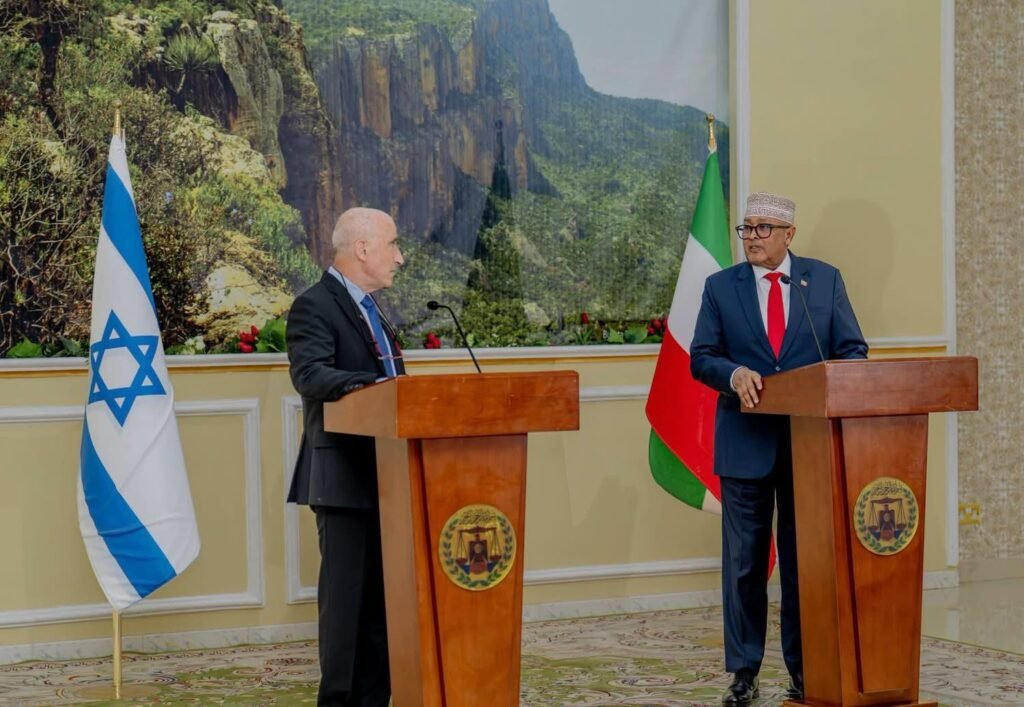
On November 1, 2026, the Israeli Ministry of Foreign Affairs announced that Ambassador Michael Lotem had presented his credentials to Somaliland’s President, Abdirahman Mohamed Abdullahi, in Hargeisa. During the visit, a ceremony was also held to lay the cornerstone for the future Israeli embassy.
The current appointment follows an earlier diplomatic breakthrough. Israel recognised Somaliland as an independent state on December 26, 2025, becoming the first UN member state to do so. The latest development marks another step towards formalising this cooperation and establishing a more permanent diplomatic framework. To understand Israel’s move, however, it is worth looking at the map.
Somaliland’s location is significant for global trade
Somaliland lies along the Gulf of Aden, in the immediate vicinity of one of the world’s most important maritime routes. Nearby lies the Bab el-Mandeb Strait, which connects the Gulf of Aden with the Red Sea. From there, shipping routes continue towards the Suez Canal and the Mediterranean Sea.
According to UNCTAD (the United Nations Conference on Trade and Development), approximately 10% of global seaborne trade by volume and around 22% of global container trade pass through the Suez Canal. Security disruptions in the Red Sea have already demonstrated how quickly geopolitical tensions can affect transport costs, delivery times and the operation of global supply chains.
By developing relations with a partner in such a strategic location, Israel hopes to expand its diplomatic opportunities in a region where maritime security, particularly in light of recent developments in the Middle East, is becoming increasingly important.
Israel’s new ambassador: what can Somaliland expect?
Cooperation between the two sides is also of strategic importance for Somaliland. Since declaring independence in 1991, the territory has been developing its own political and administrative institutions. However, the lack of broad international recognition (Israel is the only UN member state to have formally recognised Somaliland as an independent state) limits its ability to establish economic relations and attract investment.
One of Somaliland’s most important assets is the port of Berbera. Managed by DP World, the facility is developing into a regional logistics hub designed to serve not only maritime trade but also the transport of goods to landlocked countries in the region. Following the completion of the first phase of expansion, the container terminal’s capacity increased to 500,000 TEUs per year.
This infrastructure could become one of the most important elements of future cooperation. Somaliland has identified potential opportunities in technology, agriculture, water management, investment and maritime security. These are sectors in which Israeli expertise could be put to practical use.
Somalia and the African Union do not accept this change
Somalia strongly opposes closer cooperation between the two sides, as it considers Somaliland an integral part of its territory and firmly rejects its international recognition. The African Union takes a similar position, emphasising the importance of respecting the borders and territorial integrity of African states.
This dispute goes beyond Somaliland’s political status. It could also affect the stability of the entire Horn of Africa, where economic interests, as in this case, can be closely intertwined with the rivalry between regional and global powers.
Israel and Somaliland are strengthening their cooperation. What could the consequences be?
It is worth remembering that establishing diplomatic relations does not automatically give Israel access to military bases or control over Somaliland’s port infrastructure. To date, no such arrangements have been confirmed in official agreements.
Nevertheless, Somaliland could become an important partner for Israel in a region of growing strategic significance. For Somaliland, in turn, this represents an opportunity to increase its international visibility and develop economic ties. Both sides therefore stand to gain considerably from this relationship, politically, economically and in terms of security.
Taken together, these developments show that the Horn of Africa is no longer a peripheral region on the global map. An increasing number of countries and global powers are competing for influence in this strategically important part of the world.